
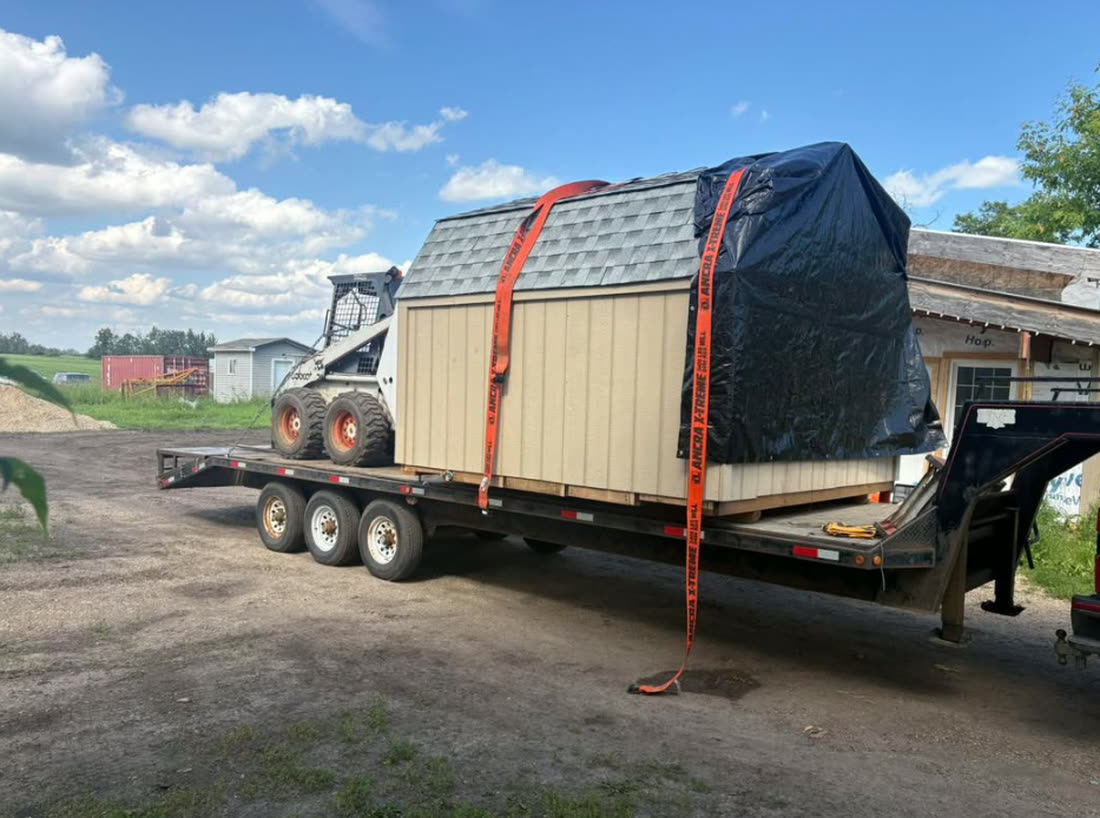
You don't need to pour a pad for one of our sheds. Each one sits on pressure-treated skids and goes straight onto the ground. What it needs is the right patch of ground, and a way for our trailer to reach it.
Delivery is a drop-and-go. We back the trailer up and slide the shed onto a clear spot that's ready for it. If the spot isn't ready, the shed can't go down, so walk the yard the week before with this list in hand.
Pick a spot that's level and firm
The skids need to sit flat. If one corner sits low, the frame can twist slightly, and doors that closed fine in our yard can start to bind.
Firm matters as much as level. Fresh fill and the low spot where water pools after rain will both settle under the weight of a shed.
To check level, lay a long straight board across the spot with a level on top, then turn the board 90 degrees and check again. If one side is clearly low, tell us before delivery day. A gravel pad fixes most of that, and we build those as part of set-up.
Leave room in front for the doors too. Our wood barn doors swing out, so that ground needs to be clear. The steel roll-up door, a $350 option, needs no clearance at all.
Skids on the ground, a gravel pad or piles
If your spot is level and firm, the shed goes right on it and there's nothing else to build.
A gravel pad is the answer for a spot that slopes a little or stays damp. It gives the skids a flat, well-drained bed and keeps them up out of standing water.
Concrete piles make sense when the ground is soft or uneven, or when you want the shed sitting high and dead level, say for a bunkhouse or studio you plan to finish inside.
We build both as part of set-up and quote them separately from the shed. Send us a photo of the spot and we'll tell you which one it needs, if either. The easiest way is to ask for a quote, then reply to the confirmation email with the photo attached.
Walk the path the trailer will take
The shed comes on our own trailer, and the trailer has to get close enough to slide it off. Walk the route from the road to the spot and look for:
- Gates and narrow gaps. A 10-foot-wide shed needs more than 10 feet of clear width the whole way, including between the house and the fence.
- Soft ground. A loaded trailer sinks where a lawn mower doesn't, especially after rain or during spring melt.
- Tight corners and retaining walls.
- Low branches and overhead lines.
If any of those apply, send a photo. We'd rather sort it out before delivery day than on it.
Check your municipality's rules
Before you settle on the spot, look up the rules for sheds and other accessory buildings where you live. How close a shed can sit to a property line, and the size at which you need a permit, differ between Edmonton, Leduc County and Strathcona County. An acreage can fall under different rules from a town lot, and newer subdivisions sometimes add their own architectural guidelines on top.
Before the trailer pulls in
Decide which way the doors should face. People forget this one, and once the shed is down it's hard to change. Then clear the route of vehicles and anything else parked along it.
Not sure your spot will work?
Ask for a quote, then reply to the confirmation email with a photo of the spot. We'll tell you what it needs before delivery day.
Questions people ask
Do I need a concrete pad?+
No. The shed sits on pressure-treated skids on a level, firm spot. If your spot needs more, we build gravel pads and concrete piles as part of set-up.
What is the floor built on?+
Pressure-treated skids, with pressure-treated joists across them at 24 inches on centre and a three-quarter-inch tongue-and-groove floor on top.
What does delivery cost?+
It's free within Edmonton. Outside Edmonton it's $2.50 per km, one way.
Can I pick it up myself?+
Yes, if you have a trailer that can carry it and a way to unload it at home. Anything finished in our yard is ready for pickup.