The first real snowfall around Edmonton tends to show you what you skipped in the fall. The barn doors won't open past a drift, or the snowblower is stuck behind the lawn mower. We build sheds in Nisku and see them in every season, so this is the short list we'd work through before the ground freezes.
None of it takes more than an afternoon. Most of it takes ten minutes with a shovel or a level.
Clear the swing, or skip it with a roll-up door
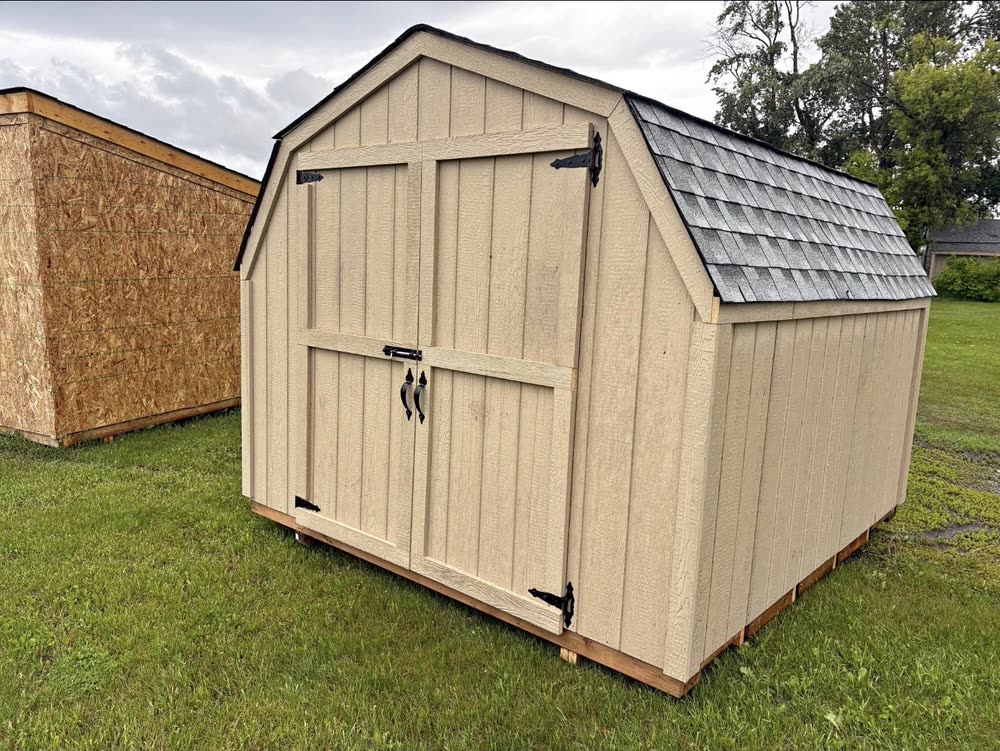
Every barn shed we build comes with wood barn doors, and they swing out. That means you need a clear arc in front of the shed every time you want in. After a storm, shovel that arc right away. Snow packs down when you walk on it, then freezes into a ridge at the threshold, and a ridge two inches high is enough to stop a door.
Shovel a little wider than the doors swing. Wind drifts snow back against the front of a shed, and you want room to chip ice without hitting the trim.
The other answer is a steel roll-up door. It's a $350 option and needs no clearance in front, so you can open it with a foot of snow on the apron. If you're pulling a snowblower out twice a week from November to March, we think it's worth the money. If the shed holds patio furniture and a summer mower, the wood doors are fine and a shovel solves the problem.
Brush the roof after the big storms
The snow to deal with is the heavy, wet dump, the kind Edmonton often gets in March. Light fluff blows off. Wet snow sits.
Use a roof rake from the ground and pull snow off toward the eaves. Don't climb up, and don't scrape down to the shingles. Our standard roof is architectural shingles, and a metal blade dragged across them strips the granules. Leave an inch or so behind and let the sun take it.
Clear the eaves on the door side first. Snow sliding off a barn-style roof lands right where you just shovelled. If you're ordering a new shed and want a metal roof instead, it's $650. Ask us whether it suits your spot.
Check level twice: at freeze-up and after the thaw
Our sheds sit on pressure-treated skids right on grade, with treated joists across them at 24 inches on centre and a three-quarter-inch tongue-and-groove deck on top. No concrete pad needed. The trade-off is that the shed moves a little if the ground under it moves, and frozen ground moves.
So check it twice a year. Once the ground has frozen hard, set a level on the floor both ways and open the doors. If they rub or won't latch, a corner has lifted. Then check again after the spring thaw, once the ground has dried and firmed up. That's the time to shim a skid, because shimming on frozen ground just sets you up to redo it in May.
Say your shed sits at a low corner of an acreage in Strathcona County where meltwater pools every April. If it keeps going out of level year after year, the fix is a better base. We build gravel pads and concrete piles as part of set-up, quoted from a photo of the spot. Send one through the quote form.
Mice and fuel cans
Mice move indoors around the first hard frost, and a shed full of grass seed is an easy winter. Get anything edible into hard bins with lids: birdseed, grass seed, dog food. Bags on the floor get chewed through in a week. Look for gaps where the floor meets the walls and around any vents, and fill them before October ends.
Fuel is the other thing to sort out. Our floors are a heavy-duty wood deck, and gas soaks into wood and stays there. Use proper fuel cans with the caps done up tight, and set them on a metal tray or a rubber mat. Keep them away from rags and bags of fertilizer. For limits on how much fuel you can store, check your own municipality's rules. They differ between Edmonton and the counties around it.
Swap the mower to the back, snowblower to the front
This is the job everyone forgets until the first storm. In late fall, run the mower, roll it to the back wall and pull the snowblower, shovels and salt up to the doors. Hang rakes and the trimmer on the side walls so the floor stays clear.
If that swap is impossible because everything is wedged in, the shed is too small. An 8 × 12 at $4,800 holds a mower and a snowblower side by side with room to walk. A 10 × 12 at $6,000 adds space for a bike rack or a workbench. Our post on what size shed you need goes through it. If you'd rather not wait for a build, check the In stock page for finished sheds sitting in our yard.
And get the firewood out of the tool shed. Wet wood stacked against a wall in an enclosed shed holds moisture all winter. Our 3 × 6 firewood shed has slatted walls so air moves through the stack, and it holds just over half a cord, about two full short-box truck loads.
Is your shed ready for snow?
If you need more room for the snowblower, or a roll-up door you can open in a drift, we'll price it in writing with build, delivery and set-up broken out. Send us a quote request or call 780 777 0881.
Questions people ask
Can I get a roll-up door instead of the wood barn doors?+
Yes. A steel roll-up door is a $350 option on our barn sheds. It needs no clearance in front, which helps when snow piles up against the shed. Call us about your shed and we'll tell you what's possible.
Do I need a concrete pad under my shed?+
No. Our sheds sit on pressure-treated skids on a level, firm spot. If your ground moves a lot, we can build a gravel pad or concrete piles as part of set-up, quoted separately from a photo of the spot.
How much is a metal roof?+
A metal roof is a $650 option. Architectural shingles are standard on every barn shed we build.
Can I insulate my shed?+
Insulation and interior lining are options priced on request. Ask us for a quote with your size and we'll put it in writing.
Do you have sheds ready to go now?+
Sometimes. Finished buildings occasionally sit in our Nisku yard ready to go, and the In stock page lists them.